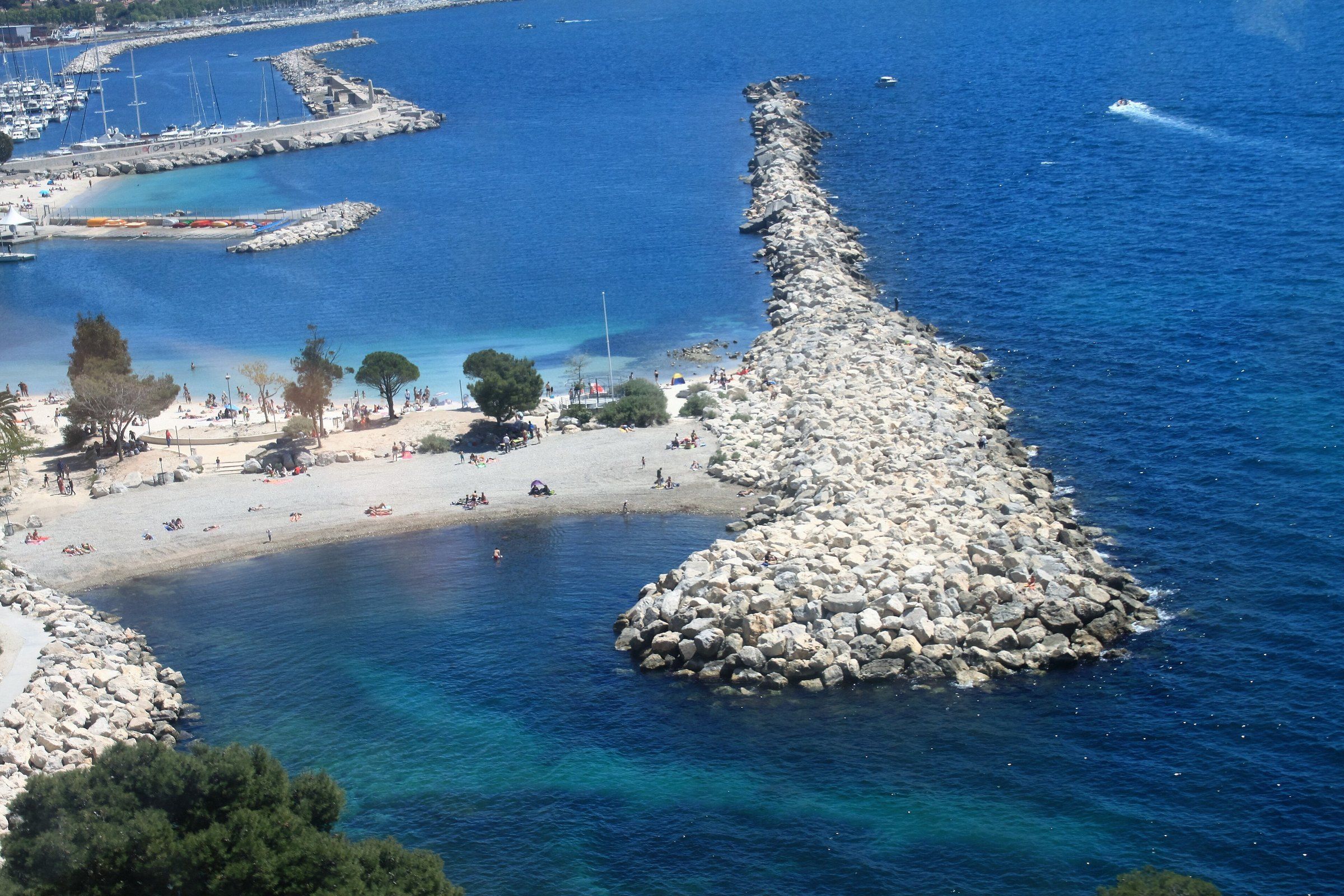
From L’Estaque, the nearest beaches are at Corbière, about 5 minutes from the villa by car: three coves of sand and pebbles, with lifeguards in summer. For quieter calanques, the Côte Bleue train leaves from L’Estaque station and reaches Niolon in 10 minutes and Carry-le-Rouet in 20 to 25. For the big beaches in the south, the Prado and Pointe-Rouge, you have to cross the city.
Further down, we’ve sorted them by what you’re after: peace and quiet, small children, swimming off the rocks, sand, the sunset.
At a glance: which beach for what
| Beach | Type | From the villa | Time | Go for |
|---|---|---|---|---|
| Corbière, L’Estaque (16th) | Fine sand and pebbles | Car, or bus 35 | about 5 min by car | Families, lifeguards close by |
| Niolon, Le Rove | Rocks, tiny beach | Train from L’Estaque station | about 10 min by train | Swimming off the rocks |
| L’Érevine, Le Rove | Small pebbles | Train to Niolon, then a footpath | 10 min by train plus about 1 hr on foot | A wild cove, walkers |
| La Redonne, Ensuès | Sand, large pebbles, rocks | Train to La Redonne-Ensuès | about 15 min by train | Quiet, a small fishing harbour |
| Méjean, Ensuès | Small sand and gravel beach | Train to La Redonne, then on foot | 15 min by train plus about 1.5 km on foot | Quiet, fried fish by the water |
| Le Rouet, Carry-le-Rouet | Half sand, half pebbles | Train to Carry | about 20 to 25 min by train | Families, lifeguards |
| Cap Rousset, Carry-le-Rouet | Sheltered rocky cove | Train to Carry | about 20 to 25 min by train | Children, snorkelling |
| La Corniche, Sausset-les-Pins | Pebbles and gravel, 600 m | Train to Sausset | about 25 min by train | A long beach and a seafront walk |
| Sainte-Croix, La Couronne | Fine sand | Train to La Couronne-Carro, then 13 to 15 min on foot | just over 30 min by train | A big sandy beach |
| Les Catalans (7th) | Sand | Shuttle boat to the Vieux-Port, then about 1 km on foot | 35 min by boat, in season | A sandy beach in town |
| Le Prophète (7th) | Fine sand, shallow water | Car, about 16 km | 25 min without traffic, longer in summer | Small children |
| Le Prado (8th) | Fine gravel | Car, about 17 km | 25 min without traffic, longer in summer | Space, sunset |
| Pointe-Rouge (8th) | Sand | Car, about 20 km | 30 min without traffic, longer in summer | Sand, water sports |
Train times are approximate. Check the day’s timetable before you set off.
Closest to the villa: the Corbière beaches
Corbière has the only beaches in the north of Marseille. They were built between 1988 and 1991, just west of L’Estaque harbour, below the Route du Rove: three coves of fine sand and pebbles, La Lave, La Batterie and Le Fortin.
From the villa, it’s the easy option: about 2.4 km by road, with parking under the viaduct. Without a car, bus 35 stops at “Corbières Base Nautique”.
On site: a lifeguard post at La Lave, lookout posts at Le Fortin and La Batterie, toilets, showers, a children’s play area and shade for a picnic. The city’s watersports centre is at La Lave too. The beach is smoke-free, and amphibious beach wheelchairs let guests with reduced mobility get into the water.
For peace and quiet: the Côte Bleue coves
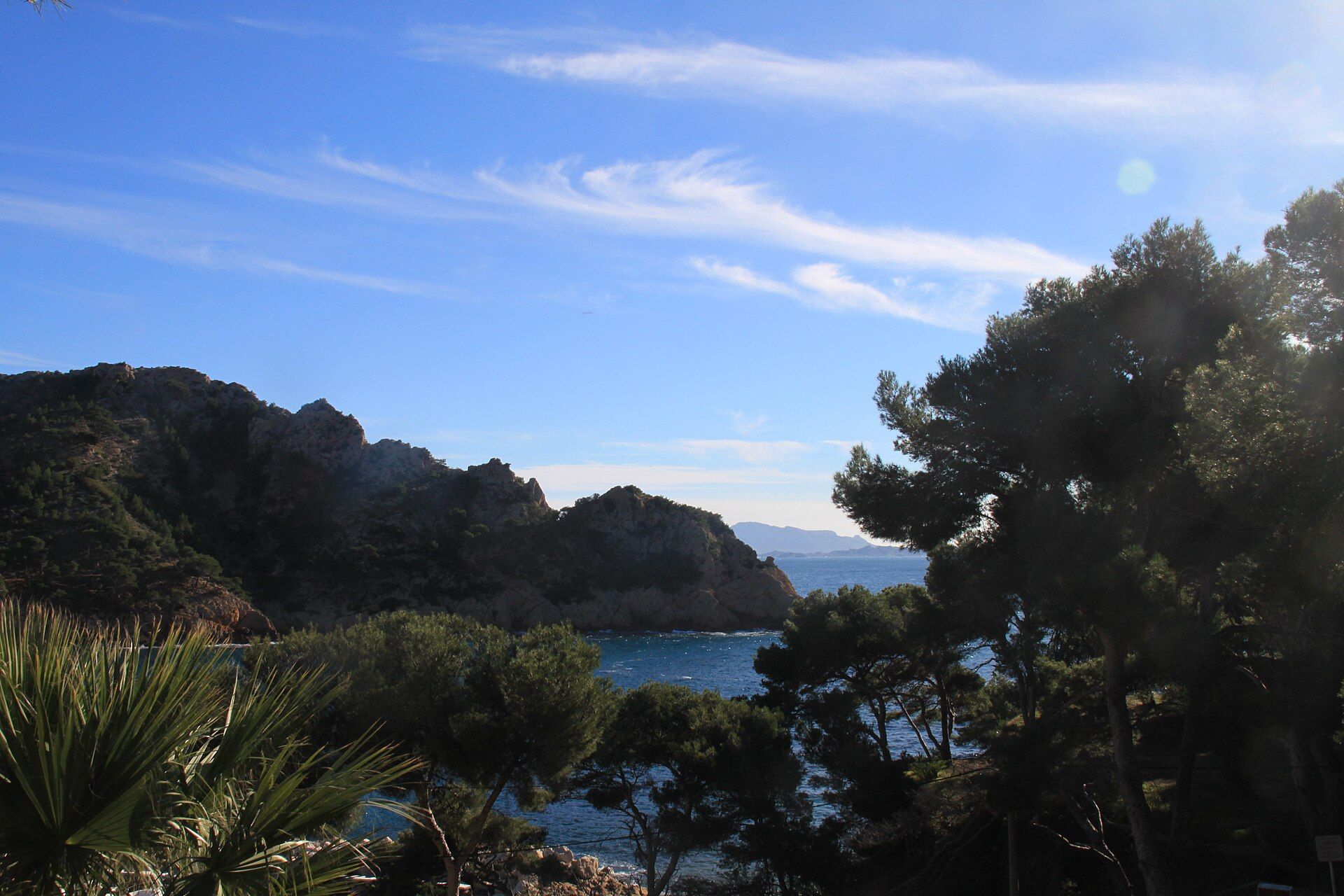
West of L’Estaque, the Côte Bleue strings together small calanques, each with its own fishing harbour. The train links them all. The line, the villages and where to eat are all in our Côte Bleue guide.
Niolon
The first real stop. The beach is tiny, so most people swim off the rocks below the cabanons. The tourism office calls parking there “difficult and limited”: come by train.
L’Érevine
The Marseille tourism office calls it “the most beautiful cove of the Côte Bleue”. You have to earn it: about an hour’s walk from Niolon station along the Sentier des Douaniers. The path is steep and slippery in places, and the water gets deep fast. In summer the small pebble beach fills up early, so aim to arrive before 10:30. Never walk along the railway line: it is forbidden and dangerous.
La Redonne
From La Redonne-Ensuès station, a road runs down to the harbour under the viaduct. There is a narrow sandy beach, another of large pebbles, and rocks to dive from a little further along. Those rocks are not for small children. There are no shops by the harbour, but L’Auberge de la Calanque opens in season.
Méjean
From La Redonne harbour, a small road follows the railway for about 1.5 km to Méjean. At Grand Méjean, a little beach of sand and gravel lines the harbour, and Le Mange-Tout serves its fried fish in season.
With children
- Corbière: lifeguards, a play area, shade and toilets, a few minutes from the villa.
- Le Prophète (7th): 260 m of fine sand, a gentle slope and shallow water, so children can wade out a long way. Lifeguard post, snack bar and showers.
- Cap Rousset, Carry: a sheltered cove inside the marine reserve, with a lifeguard post in summer and an underwater trail to follow with mask and snorkel.
- Le Rouet, Carry: the town’s largest beach, with lifeguards and access for guests with reduced mobility.
- Les Beaumettes, Carry: shallow water, but no lifeguards.
With small children, skip the rocks at La Redonne and the path to L’Érevine.
Swimming off the rocks
On the Côte Bleue, there’s Niolon, a cove divers know well, the rocks at the end of the paths around La Redonne, and L’Érevine, where the water is clear and gets deep fast. In town, the Anse de Malmousque (7th), a small fishing harbour on the Corniche, has little coves and deep water.
None of these spots has lifeguards. Swim with someone, and work out where you’ll climb out before you get in.
For sand
Round here it’s mostly pebbles and rock. For real sand:
- Pointe-Rouge (8th), the largest sandy beach in Marseille, sheltered from the wind according to the tourism office. Pedalo and paddleboard hire.
- Les Catalans (7th), the closest sandy beach to the centre, about 1 km from the Vieux-Port. It gets very busy, so go early.
- Sainte-Croix, La Couronne: two large beaches of fine sand split by a rock. One of them has access for guests with reduced mobility. Allow 13 to 15 minutes on foot from La Couronne-Carro station.
- Le Rouet, Carry, half sand.
As for the Prado beaches, despite their reputation they are fine gravel: they were built in the 1970s with the spoil from digging the metro.
For the sunset
South of the Vieux-Port, Marseille’s coast faces west towards the Frioul islands, so the sun goes down over the sea. The tourism office lists the Prado beaches, the Anse de Malmousque and the Vallon des Auffes among the best places to watch it.
On the Côte Bleue, Les Girelles in Sausset-les-Pins runs a grill by the harbour on Wednesday evenings, at sunset.
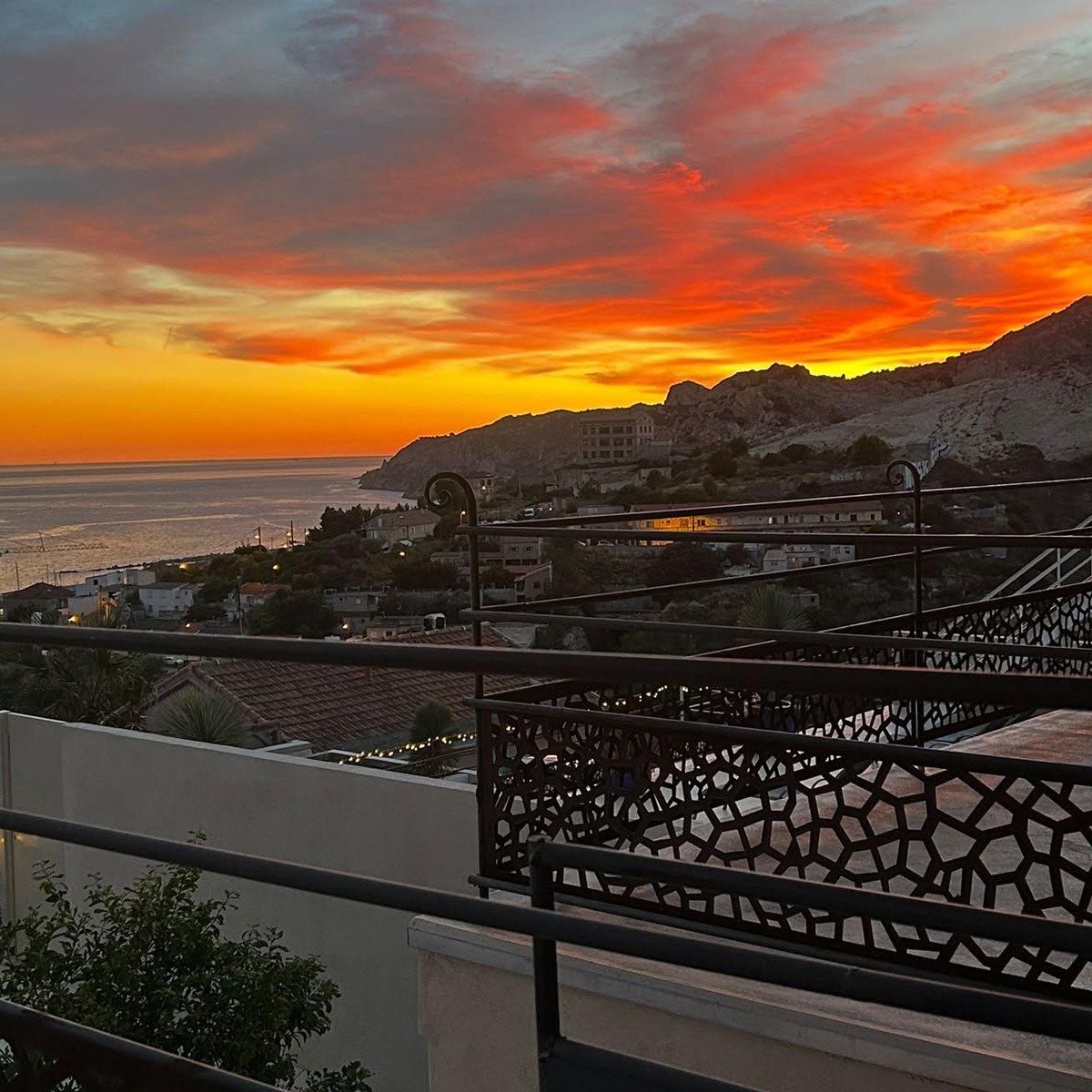
Or head back before dark: from the villa’s terrace, the sun sets over the sea beside the Côte Bleue cliffs. In June it sets further north, towards the hills.
What about the Marseille calanques?
Sormiou, Morgiou, En-Vau and Sugiton are on the other side of the city, in the Calanques National Park. Sormiou is the only calanque with a lifeguarded beach. Summer rules are strict: in 2026, the roads to Sormiou and Morgiou were closed to cars during the day from 12 June to 30 August, except for residents and restaurant guests with a booking. Our guide to the calanques from Marseille has the details.
Before you go: access, lifeguards, water quality
In summer, take the train to the Ensuès calanques
In 2026, from 18 April to 11 October, car access to the Ensuès calanques, including Méjean and La Redonne, is limited to residents registered with the town hall. The rule applies at weekends and on public holidays from 10:00 to 19:30, every day from 8:30 to 19:30 between 4 July and 30 August, and on weekday afternoons from mid-June. Otherwise, expect a fine or a tow. A shuttle bus, the C6, runs about ten trips a day at weekends and on public holidays, from the village to Grand Méjean.
The train is still the simplest way: the Niolon and La Redonne-Ensuès stations sit above the calanques.
From 1 June to 30 September, access to the forest hills is also regulated day by day according to fire risk. Before taking a path such as the one to L’Érevine, call 0811 20 13 13.
When are there lifeguards?
In Marseille in 2026, the bathing areas had lifeguards from 29 May to 30 August, 9:30 to 18:45. 104 lifeguards shared 9 posts. Les Catalans was watched from 10:00 to 19:30, Sormiou from 11:00 to 18:30.
On the Côte Bleue, each town sets its own dates, mostly July and August. At Sainte-Croix, the lifeguard post opens from mid-June to early September. Outside those periods, nobody watches the water.
At the lifeguard post, a green flag means safe swimming, yellow or orange means some danger, red means no swimming, and purple means pollution or dangerous marine life.
Water quality: where to check
The City of Marseille tests the water every day at 16 beaches, with results in 3 hours. They appear on the beach status map and in the Ville de Marseille app, updated several times a day in season. Closures tend to be short: on 5 August 2026, Les Catalans was closed in the morning and reopened in the afternoon after new tests.
Anywhere in France, the Ministry of Health site baignades.sante.gouv.fr publishes the official test results, in French. Each beach is rated excellent, good, sufficient or insufficient.
On the Côte Bleue, the town halls post closures. In late May 2026, a heavy plankton bloom closed beaches for a few days in Sausset, Carry, Ensuès and Martigues.
After the mistral, the water turns cold
The mistral pushes the warm surface water out to sea, and cold water rises from the depths. The Côte Bleue is very exposed: in early July 2026, the water at Ensuès dropped from 28 °C to 17 °C in three days. After a mistral, ease into the water slowly.
Back to L’Estaque for the evening
The train and the shuttle boat both bring you back to L’Estaque. Villa Byblos sits on the hills above the harbour, with a 180° sea view from the Frioul islands to the gates of the Côte Bleue. Four bedrooms, eight guests.
FAQ
What is the nearest beach to L’Estaque? The Corbière beaches, just west of L’Estaque harbour. Three coves of fine sand and pebbles, with lifeguards in season, about 5 minutes from the villa by car or reachable by bus 35.
Where can I swim near Marseille without a car? Take the Côte Bleue train from L’Estaque station: Niolon, La Redonne-Ensuès, Carry, Sausset and La Couronne-Carro each have a station. In season, the shuttle boat also runs to the Vieux-Port, about 1 km from Les Catalans beach.
Where is the nearest sandy beach to Marseille? In town, Les Catalans is the closest to the centre, Pointe-Rouge is the largest sandy beach in Marseille, and Le Prophète is sand too. On the Côte Bleue, Sainte-Croix at La Couronne has two large beaches of fine sand. The Prado beaches are fine gravel.
Which beach is best with small children? Le Prophète for its shallow water, Corbière because it’s close and has a play area, Cap Rousset in Carry for its sheltered cove. All three have a lifeguard post in season.
Can I drive to Méjean or La Redonne in summer? Not during beach hours: in 2026, from 18 April to 11 October, access is limited to residents at weekends and on public holidays, and every day in July and August. Take the train to La Redonne-Ensuès, or the C6 shuttle at weekends.
How do I check the water quality? In Marseille, check the beach status map on the City’s website or in the Ville de Marseille app, updated several times a day in season. Anywhere in France, baignades.sante.gouv.fr publishes the official test results.