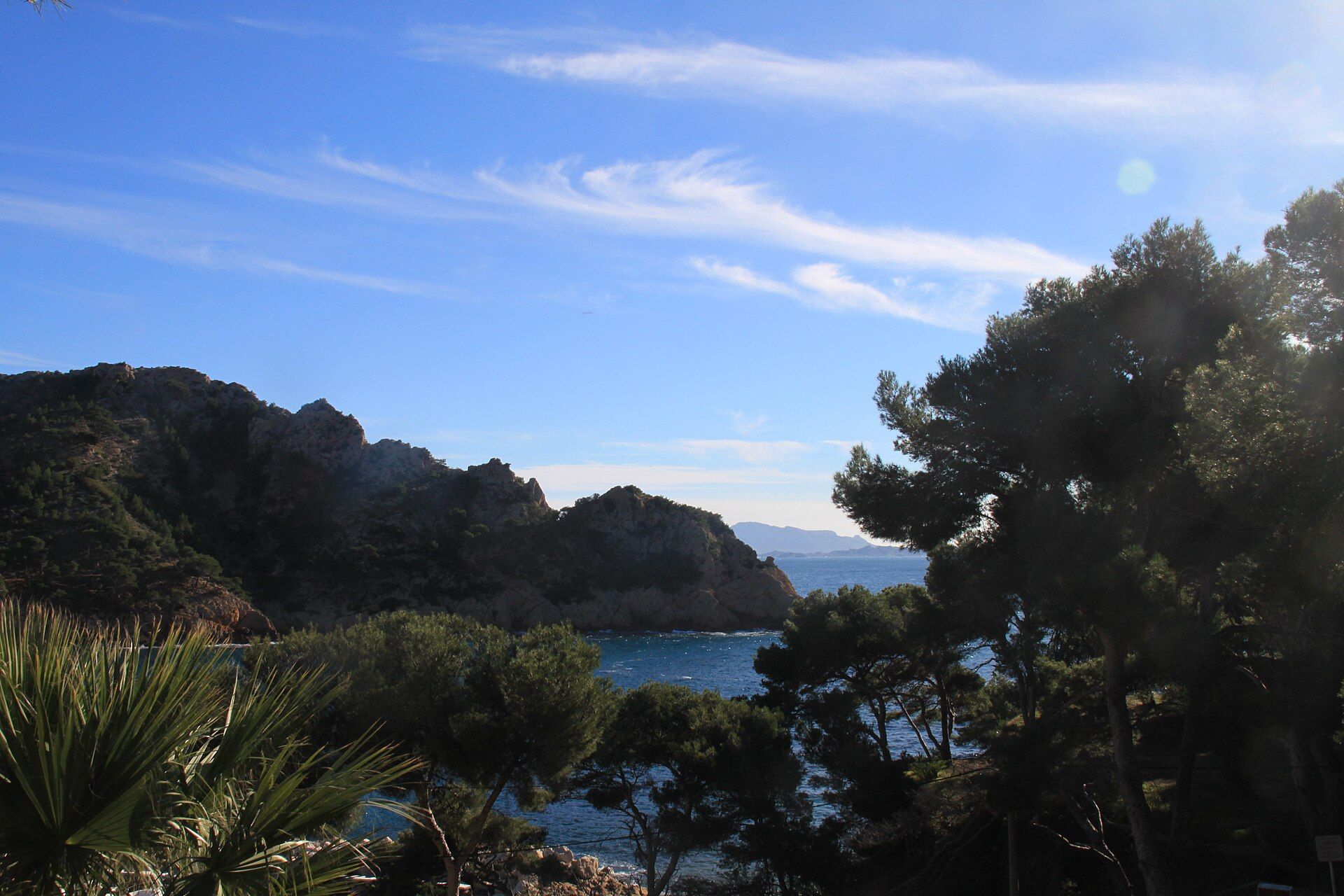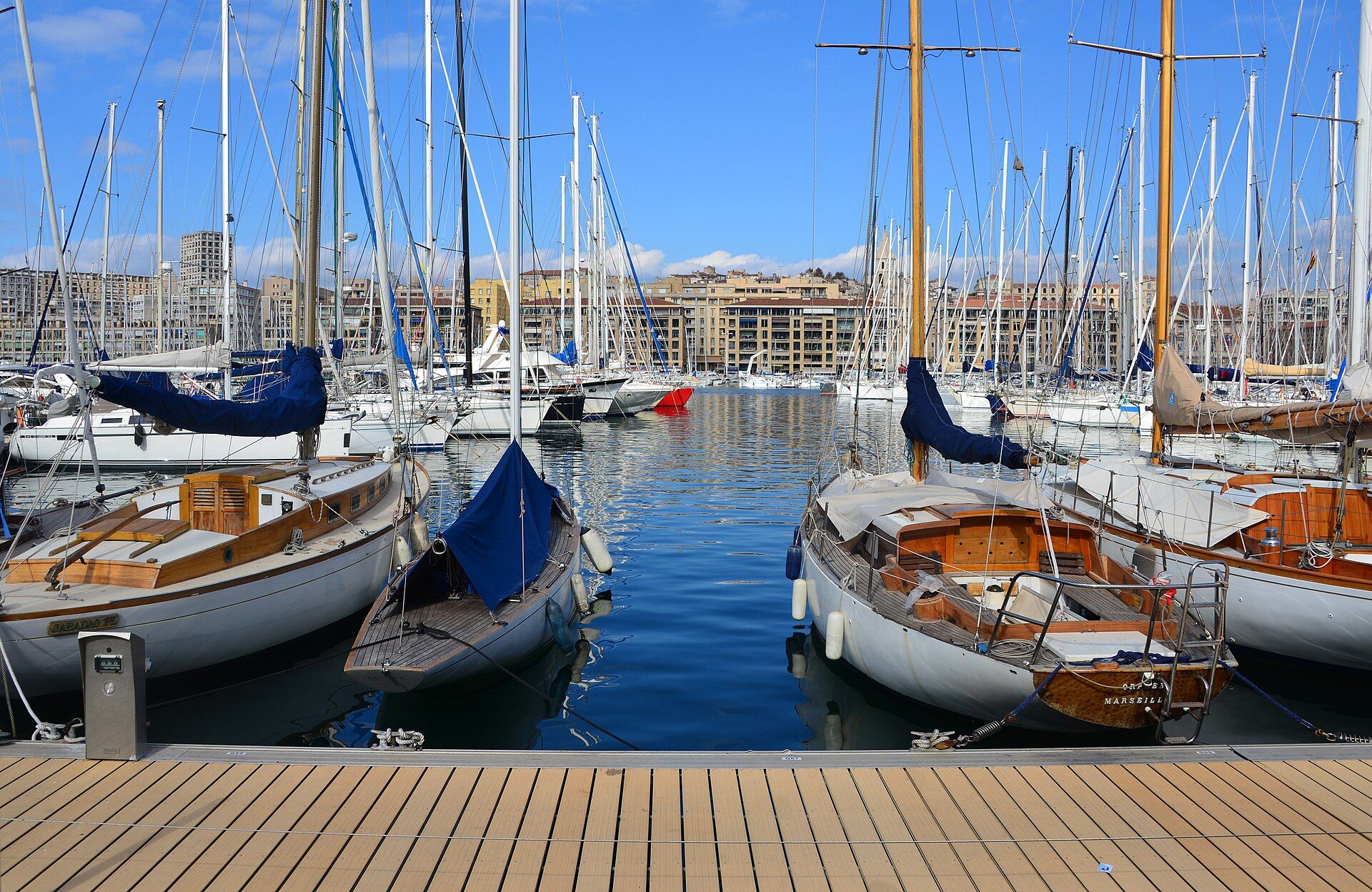
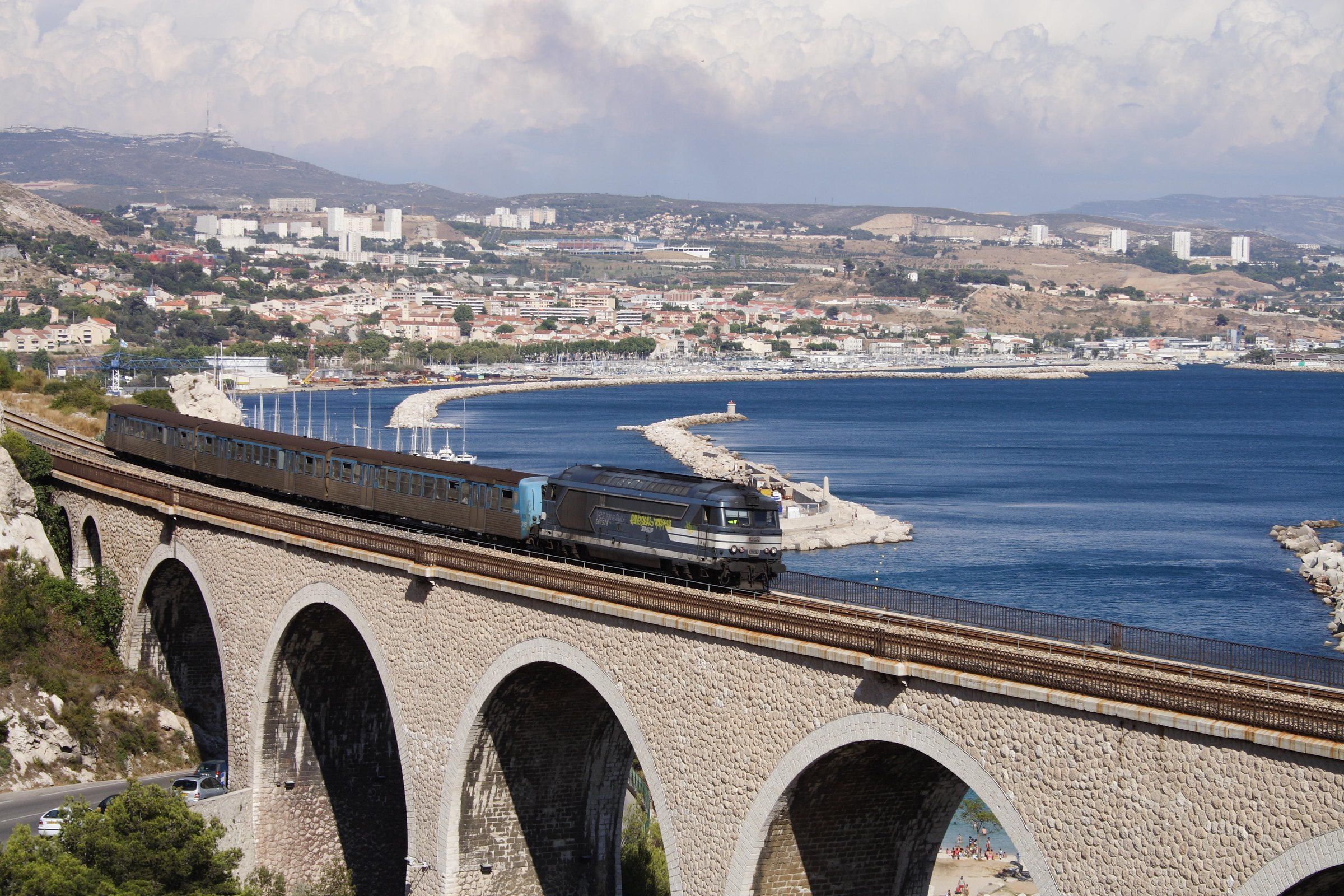
The Côte Bleue is the rocky coast that runs from L’Estaque to Martigues, west of Marseille: some 30 km of calanques, small fishing harbours and cabanons. A 1915 railway follows it, carried on viaducts. From L’Estaque station you are there in a few minutes by train.
What is the Côte Bleue?
The coast follows the foot of the Chaîne de l’Estaque, also called the Nerthe, from the Provençal nerto, myrtle. It is a limestone range about 28 km long and 8 km wide, peaking at 287 m between the sea and the Étang de Berre.
Sources put the coastline at “some 30 km”. It runs through five communes:
- Le Rove, with Niolon;
- Ensuès-la-Redonne, with Méjean, La Redonne and La Madrague de Gignac;
- Carry-le-Rouet;
- Sausset-les-Pins;
- Martigues, with La Couronne and Carro.
In Provençal it is the Còsta Blava. The same hills gave their name to a goat, the Rove goat, and to its fresh cheese, Brousse du Rove, which has an AOP.
Côte Bleue or the Cassis calanques: what is the difference?
Sormiou, Morgiou and En-Vau are in the Calanques National Park, south and east of Marseille (see our guide The Calanques from Marseille). The Côte Bleue is not part of it. It is protected by the Parc Marin de la Côte Bleue and by the Conservatoire du littoral.
The landscape is nothing alike either. Almost every cove here has its own small fishing harbour and cabanons, with the railway passing overhead on its viaducts. It also has a name for being quieter than the Cassis side. That is what the guidebooks say; nobody has measured it.
The Côte Bleue train
The coastal section of the line opened on 15 October 1915, after eight years of works. Before that, the same journey took 8 hours by horse-drawn carriage.
Along the way you cross 18 viaducts and go through 23 tunnels. The Vesse viaduct is 406 m long, the Méjean viaduct 246 m, and right at the end, in Martigues, the Caronte swing bridge stretches 1,057 m. It is often called one of the most scenic lines in France.
Stops from L’Estaque
The train leaves from L’Estaque station, opened in 1848 and a listed historic monument since 2012. After that it stops at Le Rove, Niolon, La Redonne-Ensuès, Carry, Sausset, La Couronne-Carro and Martigues. On weekdays there are about 14 trains each way.
Roughly, from L’Estaque (check the day’s timetable):
- Niolon: about 10 min.
- La Redonne-Ensuès: about 15 min.
- Carry: about 20 to 25 min.
The calanques, village by village
Niolon
The first real stop. A tiny harbour, cabanons clinging to the rock, and the Auberge du Mérou, with its terrace looking out over the bay and the Frioul islands. Bouillabaisse is made to order, so book it ahead.
L’Érevine
The Marseille tourism office calls it “the most beautiful cove of the Côte Bleue”. Part of it lies in the commune of Le Rove.
Méjean
Petit and Grand Méjean, in the commune of Ensuès. Robert Guédiguian, who grew up in L’Estaque, shot La Villa here in 2017. At Grand Méjean, Le Mange-Tout has been serving fried small fish for more than thirty years. It is closed from November to March, and you should book.
La Redonne
A fishing harbour, a station, and the end of the Sentier des Douaniers if you start from Niolon.
La Madrague de Gignac
The name comes from a madrague, a tuna trap that worked here from 1475 to 1903.
The marine park and diving at Niolon
The Parc Marin de la Côte Bleue dates from 1983. It covers 9,873 hectares of sea, including 1,049 hectares of posidonia meadows, and more than 246 fish species have been recorded there. Fishing of any kind is banned in its two reserves: Carry-le-Rouet (85 ha, 1982) and Cap Couronne (210 ha, 1996).
Divers know Niolon. France’s first diving instructor exam was held here in 1957, and the UCPA centre has been in the fort’s former lower battery since 1965. Underwater you will find red coral, octopus and nudibranchs.
Without a tank, there is still the snorkelling trail at Cap Rousset, in Carry, with a mask and snorkel.
The Sentier des Douaniers
The customs officers’ path follows the GR 51. The classic route runs from Niolon to La Redonne, about 16 km. There are cliff sections, so it is not one for small children. On the way, the ruins of the Figuerolles battery look out over the bay, the islands and Notre-Dame de la Garde.
The train solves the problem of getting back: get off at Niolon, get back on at La Redonne.
Further west, between Carro and La Couronne, a 13 km coastal path with 42 information panels runs past old quarries. Their stone went into the Abbey of Saint-Victor and La Vieille Charité in Marseille. The path then goes on to the Cap Couronne lighthouse.
Carry-le-Rouet, Sausset and Carro
Carry-le-Rouet
Above the harbour is Fernandel’s yellow villa, the “Oustaou de la Mar” (1939), which is private. Below it, a small beach carries his name, Plage Fernandel. Nina Simone spent her last years in Carry and died there in 2003.
February is oursinade season: on Sundays, people eat sea urchins on the harbour. In 2026 they took place on 1, 15 and 22 February (the 8 February one was postponed because of the weather).
For dinner, L’Oursin, run by chef Ilane Tinchant, earned one Michelin star in 2026. It is the only starred table on the Côte Bleue. The chef trained at La Villa Madie in Cassis.
Croisières Côte Bleue sails from the harbour to the calanques and the Frioul, including a trip on a glass-bottom boat.
Sausset-les-Pins
A 5 km corniche promenade on the GR 51, redone from 2024. On Wednesday evenings, Les Girelles holds a grill by the harbour at sunset.
Carro
A working fishing port, with around 30 boats and their colourful pointus. Fish is sold on the quay every morning from 8:30. When the mistral blows, Carro turns into a well-known kitesurf and windsurf spot.
Beaches on the Côte Bleue
- Le Rouet, Carry: the largest, half sand, lifeguards, views of Marseille and the Frioul.
- Cap Rousset, Carry: sheltered, good for children.
- Les Beaumettes, Carry.
- La Corniche, Sausset: 600 m of pebbles and gravel.
- Sainte-Croix, La Couronne: two sandy beaches split by a rock, by the ruins of a chapel.
To compare with the beaches in Marseille and choose by mood (with kids, somewhere quiet, a sunset), read The best beaches near Marseille.
A day on the Côte Bleue by train from L’Estaque
In the morning, take the train from L’Estaque to Niolon, about 10 min. Swim in the cove, or dive if you have booked with the UCPA. Then lunch at the Auberge du Mérou, with the bouillabaisse ordered in advance.
In the afternoon, head back to the station and on to Carry, about 20 to 25 min from L’Estaque. Le Rouet beach, or the Cap Rousset snorkelling trail with the children, then a walk round the harbour and past Fernandel’s villa.
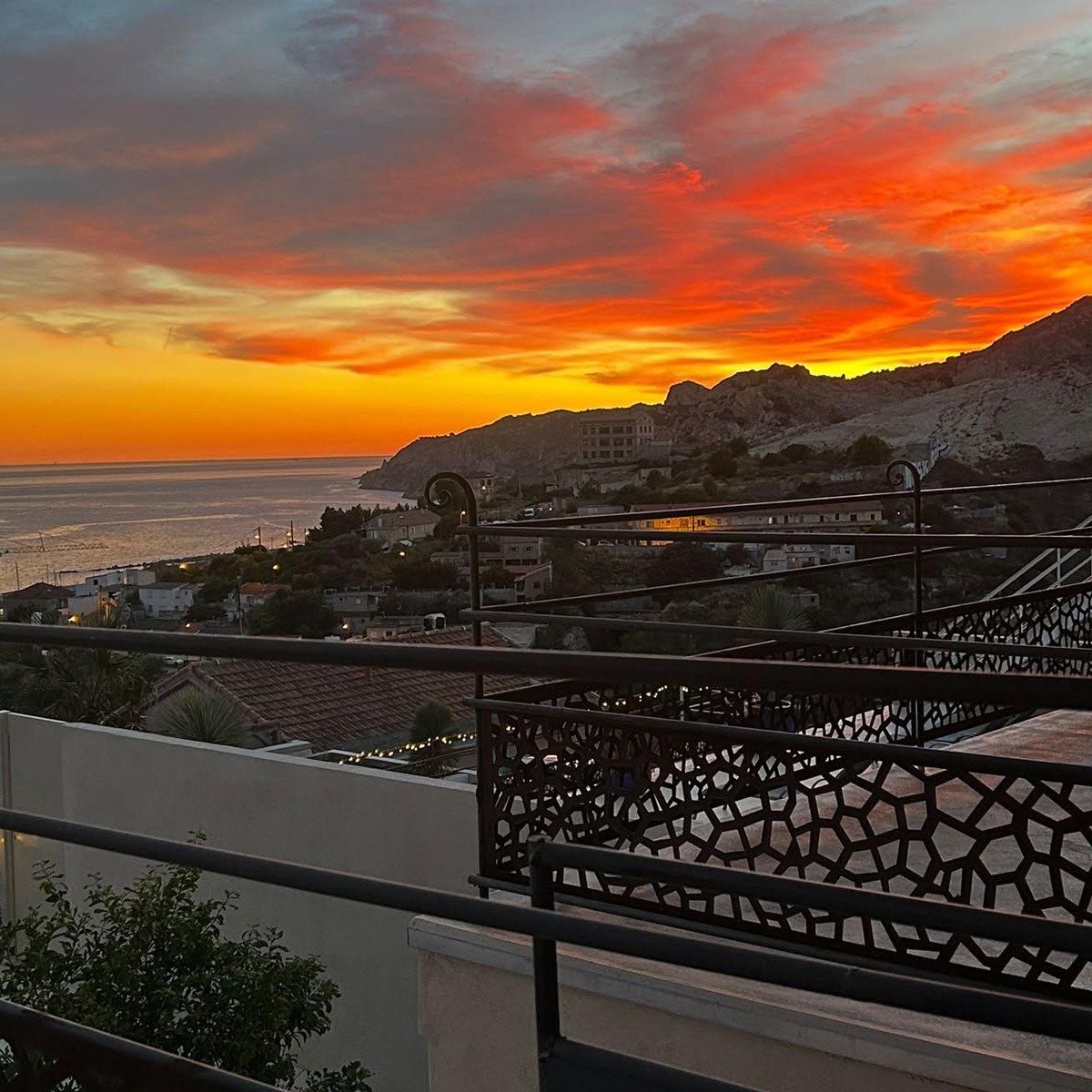
For the evening, two options: dinner at L’Oursin, if you have booked, or back to L’Estaque to watch the sun set over the sea from the terrace.
If you would rather walk, swap the morning for the Sentier des Douaniers from Niolon to La Redonne, and keep Carry for another day.
Practical rules before you go
If you are driving, forget the Ensuès calanques: from 18 April to 11 October 2026, car access is limited to residents. The C6 shuttle runs at weekends, but the train is still the simplest option.
Before a walk, think about fire risk. From 1 June to 30 September, access to the forest massifs is regulated day by day according to the risk. Check on 0811 20 13 13 before any hike.
Practical box
- From the villa: the line starts at L’Estaque station. Niolon about 10 min by train, La Redonne about 15 min, Carry about 20 to 25 min (approximate times).
- Frequency: about 14 trains each way on weekdays.
- When to come: June to September for swimming, February for the oursinades.
- Book ahead: diving at Niolon, tables at L’Oursin and Le Mange-Tout, bouillabaisse at the Mérou.
- Before a walk: massif access regulated 1 June to 30 September, info on 0811 20 13 13.
- By car: Ensuès calanques limited to residents from 18 April to 11 October 2026, C6 shuttle at weekends.
Villa Byblos, the gateway to the Côte Bleue
The Nerthe hills and the 1915 railway both start in L’Estaque. Villa Byblos sits on those hills, with a 180° sea view from the Frioul islands to the start of the Côte Bleue. In the evening the sun goes down over the sea, right beside the cliffs you walked along that day. Four bedrooms, eight guests.
CTA: See the villa / Check availability
FAQ
How do I get to the Côte Bleue from Marseille without a car? By train from L’Estaque station. The line calls at Le Rove, Niolon, La Redonne-Ensuès, Carry, Sausset, La Couronne-Carro and Martigues, with about 14 trains each way on weekdays.
Is the Côte Bleue part of the Calanques National Park? No. It is protected by the Parc Marin de la Côte Bleue, created in 1983, and by the Conservatoire du littoral.
Which is the most beautiful calanque on the Côte Bleue? For the Marseille tourism office, it is L’Érevine, “the most beautiful cove of the Côte Bleue”. Niolon and Méjean are the best known, for their harbours and their restaurants.
Can I drive to the Ensuès calanques in summer? Not in 2026: from 18 April to 11 October, access is limited to residents. Take the train, or the C6 shuttle at weekends.